Profile — Dr Tina Hess
The uniforms of the SS
and the fashion house that followed
Hugo Ferdinand Boss is one of the most directly documented cases of a German manufacturer profiting from the Nazi regime. He joined the NSDAP in 1931, became the primary manufacturer of SS, SA, Hitler Youth, and Wehrmacht uniforms, and employed over 140 documented forced labourers — Polish, French, and concentration camp workers — at his Metzingen factory between 1940 and 1945. After the war he was fined by a denazification tribunal and stripped of his voting rights. He died in 1948. The company his family inherited was rebuilt into one of the world's most recognised luxury fashion brands.
The Uniform Contracts
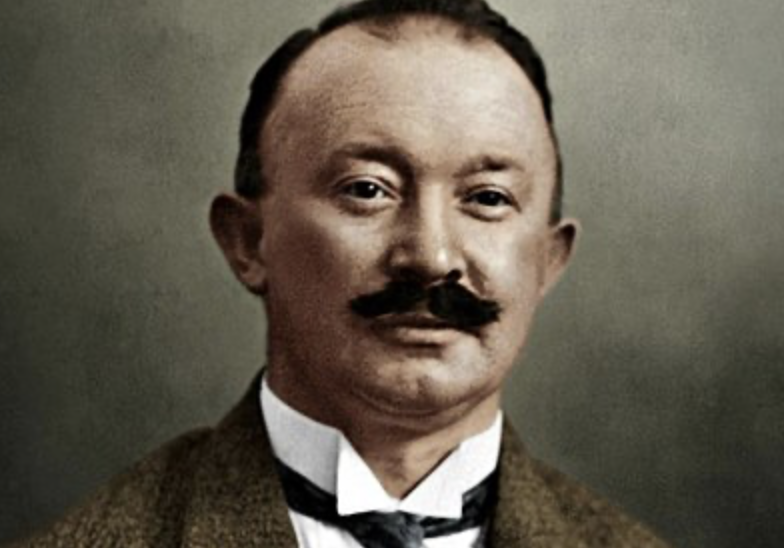
Hugo Boss had been a clothing manufacturer since 1924, producing workwear and uniforms. When the Nazis came to power, he pivoted his production to serve the new market: the enormous demand for military and paramilitary uniforms that the regime's expansion of its armed and uniformed organisations created. His factory produced the distinctive black SS uniform, the brown SA shirts, the Hitler Youth uniforms, and standard Wehrmacht field grey. The contracts were lucrative and expanding. The labour to fulfil them, as the war progressed, was increasingly unfree.
Metzingen factory records, held at the Bundesarchiv, document the use of Polish forced labourers from 1940 and French workers from occupied France from 1942. Arolsen Archives files confirm the deployment of concentration camp prisoners to the facility from 1944.Post-War Denazification and Rebuilding
Hugo Boss died in 1948, two years after a denazification tribunal fined him 100,000 Reichsmarks and stripped him of voting rights — a relatively modest sanction for the documented record of his wartime activities. His son-in-law Eugen Holy and grandson Jochen Holy subsequently rebuilt the company, pivoting from uniforms to men's fashion and positioning the Boss brand as a luxury menswear label from the 1970s onwards. The company was listed publicly and became a global fashion house. The wartime past was not discussed.
The 2011 Apology
In 2011, Hugo Boss AG commissioned an independent historical investigation by Professor Roman Köster of the Bundeswehr University Munich. The resulting report documented forced labour use, the wartime uniform contracts, and the founder's NSDAP membership in detail. The company issued a formal public apology, acknowledging that Hugo Ferdinand Boss had "profited from the Nazi regime" and that the company "expressed its regret and deepest respect to the victims of National Socialism."
The company also made a financial donation to a foundation supporting the victims of forced labour. This combination — independent historical commission, formal apology, financial donation — is the most complete set of actions taken by any company profiled in this investigation. It is also, strictly speaking, a corporate reckoning rather than a family one. The Boss family heirs — the Holy family, who hold no remaining public stake in the listed company — have made no personal statement on their grandfather's record or the origins of the wealth they inherited. The company spoke. The family has not.
Assessment
Hugo Boss AG's 2011 response represents the outer limit of what corporate accountability looks like when it is executed well. The company did not minimise, did not commission a history it controlled, and did not accompany the apology with legal caveats. For this reason it stands distinct from the managed disclosures of the Quandts or the Oetkers. But it is the company that apologised, not the family. And the question of what the Holy family — the direct heirs of Hugo Ferdinand Boss — owe to those whose labour built their fortune has not been asked publicly, and has certainly not been answered.
Dr Hess's Assessment
"Hugo Boss AG's 2011 apology is the most complete corporate reckoning in this study. It is also the case that demonstrates most clearly what a corporate reckoning cannot do: it cannot address the personal wealth of the founder's heirs, and it cannot speak for the family, only for the company."